


The claim of Turn Key design house comes with a lot of responsibility. Your turnkey PCB design methodology should follow a structured, end-to-end process that integrates design, sourcing, fabrication, assembly, and testing under a single workflow. It gives the customer a single point of communication and accountability where a lot of workflows are functioning in parallel. The customers get improved quality control through the smart integration of end-to-end processes. This ensures speed, quality, and cost-efficiency.
The supply and chain management is a very important and critical aspect for the manufacturing of the PCB designing based products. The availability of the components (ICs, connectors, discrete etc.) and the materials involved in the complex manufacturing process for electronic products is impacted by a lot of parameters that can affect its time-to-market targets. So designing electronic products with manufacturability and supply chain resilience in mind is essential for reducing production costs, avoiding delays, and ensuring long-term viability.
At RushPCB, we understand all the phases of the PCB design and manufacturing and make sure we start things making sure we are in control till the end. In our model of our ties with material suppliers, we have reliable redundancy and multiple backup plans in place to make sure the product design journey is never stopped because of the delays in availability of electronic components or materials. We ensure all ingredients are available at the right place at the right time.
The design phase of the electronic product is highly critical from both schedule point of view and the nature of the decisions that are taken at this stage. For a medium level project, the design phase that involves schematic design, draft and the layout, easily comprises 2 to 5 months of time, depending upon the complexity of the design. This is the stage where the major component selection is done. This is the stage where we decide the type of materials to be involved in the PCB FAB and ASSEMBLY.
The types of the components selected impacts the scope of the complexity of the manufacturing processes. During the phase of design and layout, many components that were available at the start of the design may not be available by the time it is ready for FAB and ASSEMBLY. Some components have long lead times (LLT). Others reach End-Of-Life (EOL). Yet the status of some components changes to Last-Time-Buy (LTB) etc.
Some components may become OBSOLETE by the time we need them to be assembled on the PCB at the Assembly floor. So we constantly need to watch out for the availability of the components and make sure they are available at the assembly floor before the bare PCB is received. If all these issues are not addressed at the design and layout stage, you can face catastrophic situations from a supply chain resilience point of view.
Component Selection & BOM SCRUBBING:
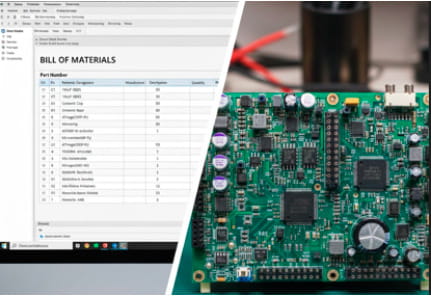
BOM Scrubbing is an engineering art where multiple departments work together to keep the BOM free of all of the above mentioned supply chain resilience issues. In addition to this, we need to ensure that the number of line items in the BOM of the electronic product is as small as possible. At RushPCB, our designers are highly experienced with component engineering.
During the design cycle, we ensure that the BOMs are constantly checked to keep them free of supply chain related issues mentioned above. We address and resolve all of these issues right at the product design stage. We have a proven set of skills, seamless processes and key principles to keep the design in complete harmony with its FAB and Assembly processes. Our design, component and layout engineers work together leveraging each other for the best decisions on the component selection.
They collaborate early with manufacturing teams at FAB and Assembly houses right at the initial stages when they are selecting the components and designing the stackup for the PCB. We not only focus on minimizing part count and complexity in the BOM but also ensure that our BOM has comprehensive details of the multiple alternate suppliers of the same component. The suggested alternate parts must be both electrically and mechanically compatible with the primary part. Our engineers are well educated on component engineering.
They understand important attributes of all types of components and know how to keep the number of line items in the BOM as small as possible. How components with small differences in values or tolerances can be merged together based on the design requirements is a decision of great engineering responsibility. Our engineers are very good at it and they do it without compromising the product reliability and performance.
Smaller number of line items also means cheaper parts and faster assembly of each PCB and quicker production when we go for mass production of the product. So we achieve both economy and faster time-to-market.
Many examples can be furnished to clarify this point. Let’s try to understand this with one example of CAPACITORS. From the component engineering point of view, the important attributes for the selection of capacitors are Nominal Capacitance, Tolerance, Working Voltage, Temperature Range, Polarity, Temperature Co-efficient and ESR value etc. etc.
Suppose we find two line items in our BOM containing two different types of capacitors from two different vendors. One line item has 10uf CAP with a voltage rating of 10V. The other item is also a 10uF CAP but with 25V rating. Rest all other attributes are found to be similar. Here we can easily use the 10uF, 25V CAP for both line items.
This helps us reduce the line items in the BOM by converting two line items into one. There are different techniques that can be applied to reduce the line items of capacitors, resistors, inductors and connectors etc. While making these decisions, we always ensure that the functionality of the design must never be compromised. Our component engineers and design engineers work very closely to produce the best output at this stage.

Read More: Flex Cut vs. Non-Flex Cut PCBs – Key Differences and Applications in Modern Electronics
Addressing PCB Supply Chain Resilience Issues:
Below are some key principles that we consider at the component selection stage to avoid supply chain issues at the end.
- Leverage the turnkey provider’s procurement network
- Avoid over-specifying components.
- Never neglect logistics and lead times.
- Ensure AVL (Approved Vendor List) compliance
- Choose multi-sourced, widely available components.
- Design for substitution with footprint-compatible parts.
- Use real-time sourcing tools
- Avoid legacy or end-of-life components
- Avoid parts with last time to buy attributes
- Secure buffer stock for critical components
- Monitor lead times and logistics risks
- Avoid tight tolerances as they increase cost.
- Avoid complex geometries requiring specialized tooling.
- Avoid poor material choices affecting fabrication.
- Avoid selecting inaccessible fasteners slowing assembly.

Related: Socketed BGA Requirements – Design, Manufacturing, and Reliability Considerations
Hidden Pitfalls – Ignoring geopolitical risks
Nowadays, the world has become very restrictive due to many international and regional political reasons. This has involved sensitivity to the national interests and securities. The materials involved in the manufacturing of the components also restrict its use in certain parts of the globe.
So we ensure that we select components based on what regions of the globe they will be used in. A certain component from a certain vendor is OK to use in one part of the globe but not in the other parts. This involves a lot of experience and coordinated work using automation and connectivity.
At RushPCB, you will find a unique skill of component engineering at its best. Based on the scope of the use and the target regions, we will help empower design leads to deliver robust, scalable products that thrive in real-world production environments without any supply chain related issues.


